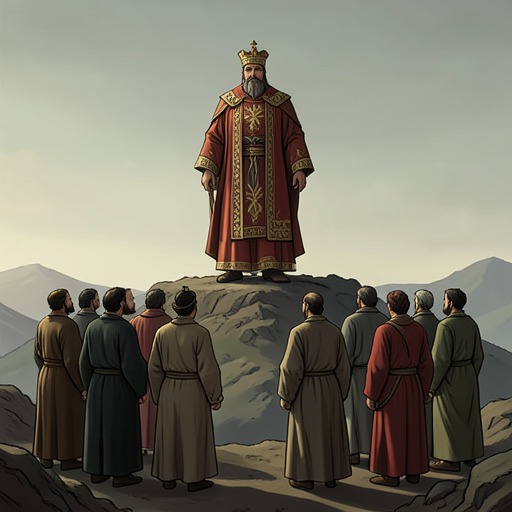
Government is the badge of lost innocence
Common Sense“Government is the badge of lost innocence” is Thomas Paine’s concise account of political authority as both a loss and a necessity. In Common Sense, government marks the point at which imperfect human virtue makes shared security require an institution of restraint; its legitimacy therefore depends on how well it protects people, not on its grandeur or inherited form.
Meaning and Context
The expression appears in Paine’s distinction between society and government. Society, he argues, is produced by human wants and positively advances people by uniting their affections; government arises from human wickedness and acts negatively by restraining vice. Society encourages intercourse, while government creates distinctions: one is a patron, the other a punisher. The badge metaphor condenses this contrast into an image of political life as evidence that an earlier condition of innocence has been lost.
Paine extends the image with the comparison of government to dress. Like clothing, it covers or marks a condition that would not otherwise be needed; the palaces of kings, he writes, stand on the ruins of the bowers of paradise. The biblical and paradisal imagery gives the political claim a moral dimension: authority is not presented as humanity’s natural glory, but as a response to its failure to live by conscience.
That failure is not described as a reason to abandon society or accept arbitrary rule. Paine’s standard is practical and comparative. Because conscience is not invariably clear, uniform, and obeyed, people surrender part of their property to protect the rest. Security is the true design and end of government, so the form that can provide it with the least expense and greatest benefit is preferable. The badge names a compromised necessity, not a license for power without limits.
From Mutual Need to Government
Paine illustrates society’s origin by imagining a small group settling in an isolated part of the earth. In natural liberty, their first thought would be society: one person’s strength cannot meet all their wants, and the mind is poorly suited to perpetual solitude. Four or five people could raise a tolerable dwelling in the wilderness, while one person might labor beyond the common period of life and still be unable to move felled timber or erect it. Hunger would draw him away from his work; illness or misfortune could leave him unable to live, even if neither were independently mortal.
Necessity would draw these settlers together like a “gravitating power.” While they remained perfectly just to one another, their reciprocal benefits could make law and government unnecessary. But as the first hardships of migration receded, the common cause binding them together would weaken, and their attachment and sense of duty could relax. Government enters at that point to supply what diminished moral virtue no longer provides. The badge thus records a transition: cooperation first answers human need, and political restraint follows when cooperation alone proves insufficient.
The imagined colony’s first institutions remain deliberately modest. A convenient tree serves as a State-House, where the entire community can assemble to deliberate. Its earliest laws may be called regulations and enforced only by public disesteem; by natural right, every person has a seat in this first parliament. As population and public business grow, distance makes universal assembly inconvenient. The community then entrusts legislative work to selected representatives, divides the colony into districts, and sends a suitable number from each part.
Authority, Representation, and Security
Representation is not, in this account, a permanent transfer of the people’s interests to a separate governing class. Paine argues for frequent elections so that the elected return within months to mix again with the electors. The prospect of returning to the general body restrains representatives from making a rod for themselves, while frequent interchange establishes a common interest across the community. Government’s strength and the governed people’s happiness rest on that continuing connection, not on the unmeaning name of a king.
This institutional account clarifies the phrase’s political consequence. If government is needed because virtue cannot reliably govern the world, its authority remains answerable to the purpose that justified it: freedom and security. Paine’s imagined representative system is meant to repair the defect in moral virtue without allowing representatives to form an interest separate from those who chose them. Frequent elections turn the need for restraint back on the rulers themselves.
Paine applies the same test to the English constitution. He acknowledges that it was a noble advance in a time of tyranny, when even a small movement away from oppression counted as a rescue. But he calls it imperfect and vulnerable to convulsions. In his account, the crown’s control over appointments has swallowed the power and weakened the virtue of the House of Commons, the constitution’s republican part. The illness is not cured by constitutional display: monarchy has poisoned the republic, leaving a political arrangement that approaches monarchical rule and fails to deliver what its forms seem to promise.
A Critique of Inherited Power
The badge metaphor also stands against the distinctions built into hereditary monarchy. Paine begins from humankind’s original equality and asks what subsequent circumstance could justify dividing people into kings and subjects. Differences between rich and poor may arise through human circumstances, but the elevation of one lineage above others has no natural or religious explanation. Political rank, in this argument, is not the innocent origin of social order; it is a distinction requiring scrutiny.
The contrast between a necessary government and a king’s inherited authority is sharpened by Paine’s proposed continental design. He advocates annual assemblies with a president only, equal representation, and domestic business subject to the authority of a Continental Congress. In his outline, each of the thirteen colonies would send at least thirty delegates, yielding a Congress of at least 390; the presidency would rotate among colonies by lot, with delegates choosing the president by ballot. A three-fifths majority would be required for legislation. These details make the alternative concrete: a government can coordinate public affairs without making hereditary sovereignty its organizing principle.
Paine further proposes a Continental Conference to frame a Continental Charter, setting the number and selection of members of Congress and assemblies, defining their jurisdictions, and securing freedom, property, and the free exercise of religion according to conscience. He insists that strength is continental rather than provincial. In the ceremony proclaiming the charter, a crown would be placed on the document to show that, so far as monarchy is approved in America, the law is king; afterward, the crown would be demolished and scattered among the people. The gesture reverses the usual image of political authority: the symbol is temporary, the law is to govern, and the people retain the right represented by the fragments.
Expedience and the Limits of Necessity
Paine warns that an institution justified by immediate necessity can become oppressive when treated as permanent. The first Continental Congress had been appointed through the assemblies because it was the readiest and then most suitable means of consultation during America’s calamities; Paine credits its wisdom with preserving the continent from ruin. But because Congress was likely to continue, the method of choosing its members deserved reconsideration. Representation and election, he asks, may be too much power for one body to possess at once. Planning for posterity requires remembering that virtue is not hereditary.
The distinction between expedience and right gives the badge a continuing force. A provisional arrangement may meet an emergency without becoming the proper foundation for lasting government. Paine points to the danger of small or unequal representation with an example from Pennsylvania: when a petition by the Associators came before the House of Assembly, only twenty-eight members were present; eight Bucks County members voted against it, and if seven members from Chester had joined them, two counties alone could have governed the province. He also objects to instructions for provincial delegates that had been approved by very few people outside the assembly and then passed in the name of the whole colony.
The phrase therefore does not merely condemn government as a regrettable institution. It sets a condition on its use. Since authority becomes necessary when human beings fail to sustain justice through mutual duty alone, it must remain limited, representative, and directed toward security. When it abandons those purposes—when it becomes a source of arbitrary distinctions or turns emergency convenience into enduring domination—the badge no longer signifies the least necessary evil; it exposes a government that has made its own justification a pretext.